
The Mirage of the Archive
Every engineering team makes hundreds of decisions a week. Almost none of them survive the sprint. We live in an era of unprecedented recording, yet we suffer from a profound lack of remembrance. We have more tools than ever to capture text, yet our organizations are more forgetful than they were a decade ago. This is the central paradox of modern engineering leadership: we are drowning in records but starving for context. As a CEO, I have watched brilliant teams stumble not because they lacked talent or vision, but because they lost the thread of their own organizational judgment. They recorded their choices, but they failed to remember them.
Recording is a passive act. It is the simple movement of data from a human mind to a digital repository. It is easy, it is cheap, and in the long run, it is often useless. Remembering, however, is an active, structural necessity. To remember is to bring the past into the present moment of action. It is the difference between a forgotten PDF sitting in a cloud folder and a developer receiving a notification in their IDE because they are about to violate a hard-won architectural consensus. At Hopsule, we believe that for an engineering organization to scale, it must move beyond the culture of recording and embrace the discipline of remembrance.
When we talk about the "memory" of an organization, we are talking about its ability to maintain its integrity over time. When a senior architect leaves, their recordings remain, but their memory often departs with them. The result is a slow, agonizing drift toward technical debt and inconsistent patterns. We built Hopsule to stop this drift. We built it to ensure that the "Why" behind every line of code is as durable as the code itself.
The Decay of Passive Records
Traditional methods of capturing engineering decisions fail because they treat information as a static asset. They assume that if you write it down, people will find it, read it, and follow it. This assumption is fundamentally flawed. In a high-velocity environment, developers do not have the luxury of searching through a documentation graveyard before every pull request. The friction of retrieval is the enemy of adherence. When decisions are merely recorded, they are effectively buried. They exist in a state of entropy, slowly losing their relevance as the project evolves and the team grows.
Remembrance requires a different architecture. It requires a system where decisions are not just text, but first-class entities with a lifecycle. This is why the Hopsule Dashboard treats decisions as enforceable constraints. A decision in Hopsule is not a "note"; it is a commitment. It has a status—Draft, Pending, Accepted, or Deprecated. It has authority. By transforming a record into a governed decision, we move from a world of passive archives to a world of active governance.
Decision-First Governance: Beyond the Text
The fundamental unit of progress in an engineering organization is the decision. Not the task, not the ticket, and certainly not the meeting. Every meaningful change in a system is the result of a choice made between competing priorities. Yet, most teams treat these choices as ephemeral. They happen in Slack threads, in hallway conversations, or in the minds of individual contributors. When these choices are not formalized, the organization loses its ability to govern itself.
Decision-first governance is the philosophy that our primary output is not just code, but the preserved logic of our choices. When a team agrees to use a specific pattern for error handling or a particular strategy for database sharding, that agreement must be preserved with the highest degree of fidelity. It must be searchable, versioned, and, most importantly, linked to the reasoning that birthed it. This is where the distinction between decisions and memories becomes critical.
In Hopsule, a decision is the "What"—the explicit commitment the team has made. But a decision without a memory is just a rule without a reason. Memories are the "Why." They are append-only entries that capture the history, the lessons learned, and the context of the decision. Unlike traditional systems where records are overwritten and history is lost, Hopsule memories are permanent. They provide the traceability required to understand why a decision was made three years ago by someone who is no longer with the company. This preservation of organizational judgment is what allows a team to evolve without repeating the mistakes of the past.
Enforcement as Remembrance, Not Control
The word "enforcement" often carries a negative connotation in engineering circles. It suggests a rigid, top-down control that stifles creativity. But at Hopsule, we view enforcement differently. We believe that enforcement is simply the highest form of remembrance. If you truly remember a decision, you do not violate it by accident. Most deviations from architectural standards are not acts of rebellion; they are acts of forgetting.
This is the core insight behind Hopsule for VS Code. By bringing decision enforcement directly into the IDE, we are not trying to control the developer; we are trying to help them remember what the team already agreed upon. When a developer writes code that contradicts an accepted decision, the IDE extension surfaces a warning. This is not a "blocker" in the bureaucratic sense, but a contextual nudge. It says: "The team decided on X for reason Y. You are currently doing Z. Are you sure?"
The Contextual Nudge
This real-time feedback loop is essential for maintaining the integrity of a complex system. It shifts the burden of memory from the individual to the environment. Instead of expecting every engineer to have a perfect mental map of the entire decision history of the organization, we embed that map into the tools they use every day. This is the essence of context-aware engineering. Whether you are using the Hopsule CLI to check the status of a project or browsing the Hopsule Dashboard to understand the current governance state, the goal is always the same: to reduce the cognitive load of remembrance.
When enforcement is treated as remembrance, it becomes a service to the developer. It provides a safety net that allows them to move faster, knowing that the system will catch them if they inadvertently stray from the team's established path. It transforms the IDE from a simple editor into a portal for organizational memory.
The Portability of Context: Context Packs
One of the greatest challenges in modern engineering is the fragmentation of context. Teams are often siloed, and projects are frequently spun up with little regard for the lessons learned in previous efforts. When a developer moves from Project A to Project B, they often have to "re-learn" the organizational culture and technical standards from scratch. This is a massive waste of human capital.
We solved this problem through the creation of Context Packs, or Capsules. A Capsule is a portable bundle of decisions and memories that can be shared across projects, teams, and even organizations. It is a way to package expertise and make it mobile. If your organization has a "Gold Standard" for security or a "Core Architecture" for microservices, those can be encapsulated and applied to every new project instantly.
Capsules are designed to survive time and organizational change. They have their own lifecycle—Draft, Active, Frozen, and Historical. By using Context Packs, an organization can ensure that its most important decisions are not trapped within the walls of a single repository. They become a living part of the company's DNA, easily accessible via the Hopsule API or the Hopsule CLI. This portability is what allows an engineering culture to remain consistent as it scales from ten developers to ten thousand.
The Advisory AI: Hopper and the Role of Assistance
In the current hype cycle, there is a lot of talk about AI making decisions for humans. At Hopsule, we take a different stance. We believe that humans should decide, and AI should assist. This is the philosophy behind Hopper, our built-in AI assistant. Hopper is not an authority; it is an advisor. It is powered by your team's existing decisions and memories, which means its advice is always grounded in your specific context.
Hopper can help you draft a new decision from natural language, detect potential conflicts between proposed changes and existing commitments, or explain the history of a complex architectural shift. But Hopper never accepts a decision on its own. The authority always remains with the human team. This distinction is vital for maintaining accountability and governance. An AI can suggest, but it cannot judge. Organizational judgment is a human faculty, and our goal is to amplify it, not replace it.
The Context-Aware Agent
The rise of AI agents in the coding process has created a new set of challenges. An AI agent, no matter how powerful, is only as good as the context it is given. If an agent is writing code without knowledge of your team's decisions, it will inevitably produce code that is technically functional but organizationally wrong. It might use the wrong library, ignore a security constraint, or violate a naming convention.
This is why we developed Hopsule MCP (Model Context Protocol). Hopsule MCP allows any compatible AI agent to connect directly to your team's decisions and memories. It provides the agent with the "rules of the house" automatically. When an agent has access to your Hopsule context, it becomes a better collaborator. It stops hallucinating patterns that don't exist and starts adhering to the standards you have worked hard to establish. This is the future of AI in engineering: not as a replacement for developers, but as a context-aware participant in the team's collective memory.
Visualizing the Brain: The Knowledge Graph
Decisions do not exist in isolation. They are interconnected, forming a complex web of dependencies and consequences. A decision about your data schema will inevitably impact your decisions about API design, which in turn will affect your front-end architecture. Understanding these relationships is nearly impossible when they are buried in static documents.
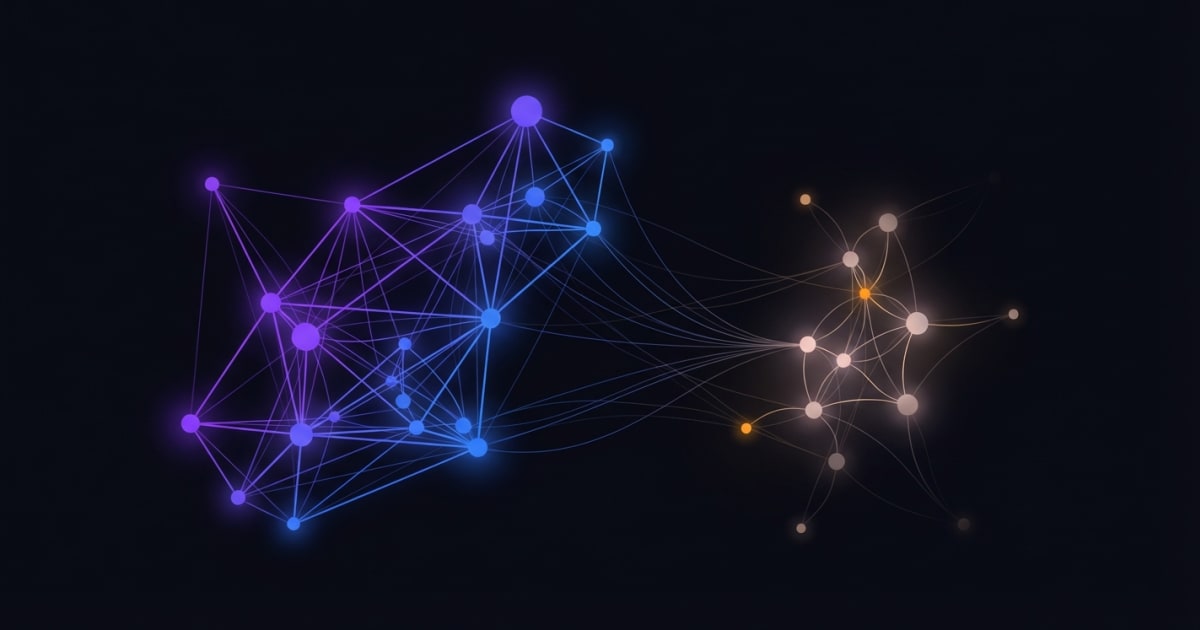
The Hopsule Knowledge Graph, which we often call the "Brain," provides a visual representation of these connections. It allows engineering leaders to see the ripple effects of their choices. By visualizing the relationships between decisions, memories, and capsules, the Brain provides a high-level view of the organization's intellectual landscape. It helps identify "bottleneck" decisions that everything else depends on, and it highlights areas where the team's memory might be thin or fragmented.
This visualization is more than just a pretty chart; it is a tool for strategic governance. It allows a CTO or a VP of Engineering to see the health of their organization's judgment at a glance. It turns the abstract concept of "organizational memory" into a tangible, navigable asset. When you can see the Brain of your organization, you can lead it with much greater clarity and confidence.
The Future of Engineering is Contextual
We are moving toward a world where the primary differentiator for an engineering team will not be the languages they use or the frameworks they choose, but the quality of their organizational memory. As systems become more complex and AI plays a larger role in the development process, the ability to preserve, enforce, and share context will be the only thing that prevents total chaotic drift.
Hopsule is more than a tool; it is a new way of thinking about how engineering teams function. It is a move away from the "record and forget" mentality and toward a culture of active remembrance. Whether you are a solo developer using Hopsule to maintain your own personal standards or an enterprise organization using Hopsule Enterprise for full data sovereignty and self-hosted governance, the mission is the same: to ensure that your decisions have the authority they deserve.
The difference between remembering and recording is the difference between an organization that learns and one that merely accumulates data. Recording is about the past; remembering is about the future. By investing in a dedicated decision and memory layer, you are not just managing information—you are preserving the very soul of your engineering organization. You are ensuring that when the next generation of developers arrives, they won't just find a graveyard of text; they will find a living, breathing system of judgment that guides them toward excellence.
As we continue to build Hopsule, our focus remains on this core philosophy: Enforcement is remembrance, not control. We invite you to join us in this shift. Let us stop just recording our choices and start truly remembering them. The integrity of your systems, the speed of your team, and the longevity of your vision depend on it.
SHARE ON SOCIAL MEDIA