
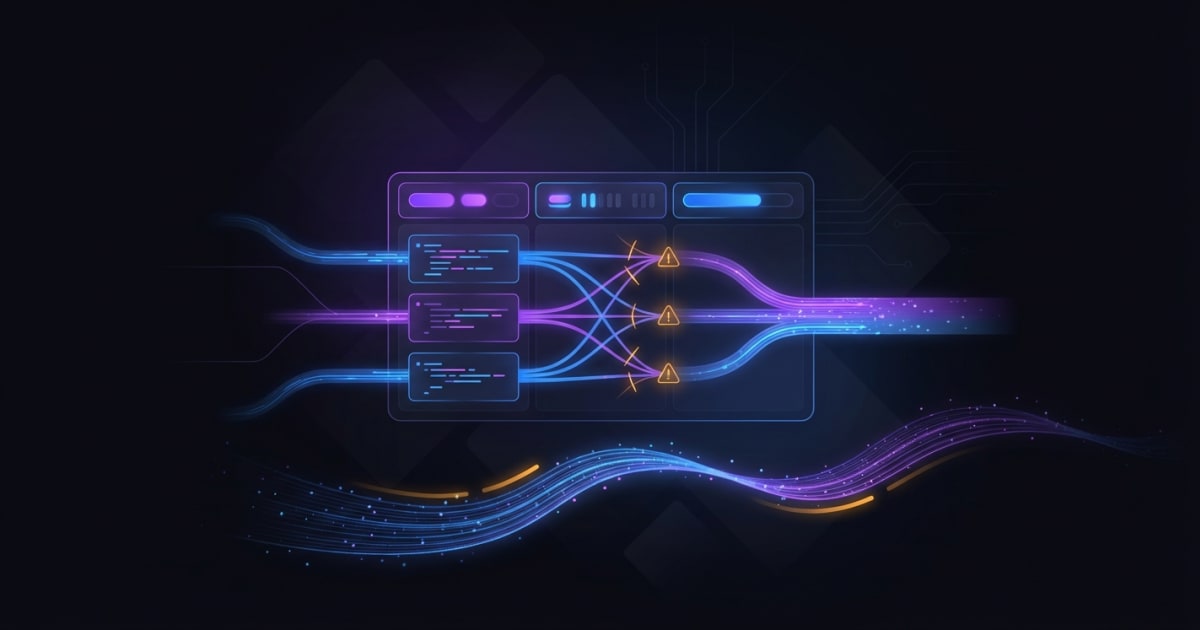
When you run hopsule decision create from your terminal, you aren't just adding a line to a ledger. You are asserting a new reality for your engineering team. In that moment, Hopsule begins a silent, rigorous process of cross-referencing this new assertion against every previous commitment your organization has ever made. This is not a simple text search. It is the activation of a context-aware memory system designed to ensure that your future does not accidentally sabotage your past. In engineering, we often talk about "technical debt," but the more insidious version is "decision debt"—the accumulation of contradictory, forgotten, or ignored mandates that paralyze a team's ability to move with speed and certainty.
As the CTO of Hopsule, I have spent countless hours observing how engineering organizations lose their way. It rarely happens through a single catastrophic failure. Instead, it happens through the slow erosion of organizational judgment. A team decides to use a specific architectural pattern in January, forgets the reasoning by June, and by December, they are implementing a contradictory pattern that breaks their infrastructure's internal consistency. Hopsule exists to stop this erosion. Our conflict detection engine is the core of this mission. It is the mechanism that keeps your codebase honest by ensuring that every decision is enforced through remembrance, not through arbitrary control.
The Anatomy of a Decision Conflict
To understand how Hopsule preserves context, we must first define what a conflict actually is within our ecosystem. In Hopsule, a conflict occurs when a new proposed decision—currently in the Draft or Pending state—overlaps with or contradicts an Accepted decision. Because Hopsule treats decisions as first-class, enforceable entities rather than static text, these conflicts are detected at the logical level. When you submit a decision via the Hopsule CLI or the Hopsule Dashboard, the system evaluates the intent and the constraints defined within the decision's metadata.
Consider a scenario where an organization has an accepted decision stating that all external API integrations must use a specific mutual TLS (mTLS) handshake. Three months later, a developer—unaware of this specific governance—proposes a new decision to streamline integrations using a standard OAuth2 flow without mentioning mTLS. In a traditional environment, this would be buried in a legacy system or a forgotten email thread. In Hopsule, the system identifies the overlap immediately. It recognizes that the new proposal touches the same domain (External Integrations) but fails to satisfy the existing constraint (mTLS requirement).
This detection is powered by the Knowledge Graph, often referred to as the "Brain" within the Hopsule Dashboard. The Knowledge Graph maps the relationships between decisions, memories, and the context packs they belong to. When a conflict is detected, the system doesn't just block the user; it provides the Memories associated with the conflicting decision. It shows you the why. It might surface a memory entry from a year ago explaining that mTLS was mandated following a specific security audit. This is the essence of remembrance: we don't just tell you "no," we tell you why the current "yes" exists.
Logical Overlap vs. Explicit Contradiction
Conflicts in Hopsule fall into two categories. An explicit contradiction is straightforward: Decision A says "Use Database X," and Decision B says "Use Database Y." These are caught instantly. However, the more valuable detections are logical overlaps. This is where Hopper, our built-in AI assistant, excels. Hopper analyzes the semantic meaning of your decisions and memories. It can detect when a new decision about "Service-to-Service Communication" might conflict with an older decision about "Network Latency Thresholds," even if the words used are entirely different. This ensures that the governance remains robust even as the team's vocabulary evolves over time.
Hopper: The Advisory Layer of Remembrance
It is important to clarify a fundamental principle of our philosophy: Hopper is advisory, never authoritative. In the Hopsule ecosystem, humans make decisions, and the system assists in their enforcement and preservation. When you are drafting a decision in the Hopsule Dashboard, Hopper acts as a real-time auditor. As you type, it queries the Decision & Memory Layer to find relevant historical context that might influence your current thinking.
If you attempt to move a decision from Draft to Pending while a conflict exists, Hopper will flag it. It will present a "Conflict Analysis" report, which is visible to all stakeholders. This report doesn't just list the conflicting ID; it synthesizes the reasoning. It might say: "This proposal suggests using a centralized logging service, but Decision #442 (Accepted) mandates decentralized logging for GDPR compliance in the EU-West region. Additionally, Memory #89 indicates that a previous attempt at centralized logging resulted in a 15% latency increase."
By surfacing these memories, Hopsule transforms a potential argument into a data-driven discussion. The team can then choose to Deprecate the old decision if the context has truly changed, or they can revise the new proposal to align with existing governance. This lifecycle—moving from Draft to Pending to Accepted—is how we ensure that only the most robust, context-aware decisions become part of the organization's permanent memory.
The Role of Memories in Conflict Resolution
Memories are the append-only history of your organization. Unlike decisions, which have a lifecycle and can be deprecated, memories are never deleted. They provide the traceability required for true governance. When Hopper detects a conflict, it pulls from these memories to explain the reasoning behind the status quo. This prevents "Chesterton's Fence" scenarios where a team removes a constraint without understanding why it was put there in the first place. Every conflict detected by Hopsule is an opportunity to revisit these memories and decide if the reasoning still holds water in the current environment.
Real-time Enforcement with Hopsule for VS Code
The most powerful aspect of Hopsule's conflict detection is that it doesn't just live in a dashboard; it lives where the code is written. Hopsule for VS Code (and our extension for Cursor) brings decision enforcement directly into the IDE. This is where the concept of "Enforcement is remembrance" becomes tangible for the individual contributor. If an engineering leader has accepted a decision regarding specific error-handling patterns, the IDE extension will surface a warning if the developer writes code that contradicts that decision.
This is achieved through a local processing layer. Hopsule for VS Code syncs with your team's Context Packs (Capsules) and monitors the workspace. It doesn't send your source code to our servers; instead, it uses the decisions and constraints defined in Hopsule to provide inline feedback. If you are working on a file that falls under the scope of an Accepted decision, the sidebar tree view will highlight the relevant constraints. If your code violates a decision, you see a warning—not as a linter error, but as a governance reminder.
This creates a feedback loop that is much tighter than a weekly sync or a code review. The developer is reminded of the team's collective judgment in real-time. If the developer believes the decision is outdated, they can't just ignore the warning; they are encouraged to initiate a "Decision Override" or propose a new decision via the Hopsule CLI. This ensures that every deviation from the established path is intentional and documented, rather than accidental and forgotten.
The Decision Sidebar and Conflict Visualization
Inside VS Code, the Hopsule extension provides a dedicated view of the "Project Brain." This is a localized version of the Knowledge Graph. It allows developers to see how their current file relates to the broader decision-making structure of the organization. When a conflict occurs—for example, if a developer is trying to implement a library that was explicitly deprecated in a previous decision—the extension will highlight the contradiction in the sidebar. This visual cue serves as a constant reminder of the organizational judgment that should be guiding the implementation.
Hopsule CLI: Governance at the Speed of Terminal
For many of us, the terminal is the primary interface for engineering work. The Hopsule CLI is designed to be the bridge between the developer's local environment and the organization's memory system. It is a highly interactive tool that allows for the creation, listing, and management of decisions without ever leaving the command line. When you execute hopsule status, you get a comprehensive view of your project's alignment with its assigned Context Packs.
The CLI is also the primary tool for CI/CD integration. By incorporating the Hopsule CLI into your deployment pipelines, you can ensure that no code is merged if it contradicts an Accepted decision. This is not about "blocking" developers; it is about ensuring that the code reflects the team's current commitments. If a conflict is detected during a CI run, the CLI will output a detailed report, including the ASCII-art visualization of the conflict within the Knowledge Graph, and point the developer toward the relevant memories in the Hopsule Dashboard.
The interactive TUI (Terminal User Interface) within the CLI provides a dashboard-like experience for managing decisions. You can view the full version history of a decision, see who accepted it, and read the linked memories. This makes the Hopsule CLI an essential tool for "Solo Mode" developers as well. Even if you are working alone, the CLI acts as your external memory, preventing you from making contradictory choices across different projects or over long periods of time.
Automating Decision Lifecycle via CLI
One of the most effective patterns we see in high-performing teams is the automation of decision transitions. Using the Hopsule API in conjunction with the CLI, teams can trigger decision reviews based on specific events. For example, if a decision has been in the Accepted state for over a year, a script can automatically move it to Pending for a "re-validation" review. This ensures that the organization's memory remains fresh and that old decisions don't become stale "zombie" constraints that no longer serve the team's goals.
Context Packs and the Portability of Authority
Engineering organizations are rarely static. Projects start, finish, merge, and split. People move between teams. In a traditional setup, the context of why certain decisions were made is lost during these transitions. Hopsule solves this through Context Packs (also known as Capsules). A Context Pack is a portable bundle of decisions and memories that can be shared across projects, teams, and even different organizations.
Conflict detection becomes even more critical when dealing with Context Packs. When you import a "Security Context Pack" into a new "Frontend Project," Hopsule immediately checks for conflicts between the project's existing decisions and the newly imported constraints. This prevents a "collision of authorities." If the Frontend Project had a decision to use a specific local storage mechanism that the Security Context Pack forbids, Hopsule will flag this contradiction the moment the pack is activated.
This portability ensures that organizational judgment survives time and structural changes. A "Core Infrastructure" team can maintain a Context Pack of foundational decisions that every other team in the company must follow. When a new team starts a project, they simply subscribe to that Capsule. The Hopsule MCP (Model Context Protocol) server then ensures that any AI agents the team uses—whether in Cursor, Claude, or custom tools—are automatically aware of these decisions. The AI becomes context-aware by default, and because it has read-only access to the decisions, it can advise the team on potential conflicts before they even write a single line of code.
Lifecycle of a Capsule: From Draft to Historical
Context Packs have their own lifecycle: Draft, Active, Frozen, and Historical. Conflict detection behaves differently depending on the state. An Active pack is the current source of truth, and any new decision must align with it. A Frozen pack is used for long-term preservation, ensuring that the decisions within it cannot be altered, providing a stable reference point for audit and compliance. By managing the state of these Capsules, engineering leaders can control the flow of authority across their entire organization, ensuring that the right decisions are enforced at the right time.
Visualizing the Brain: The Knowledge Graph
The Knowledge Graph (or "Brain") in the Hopsule Dashboard is not just a pretty visualization; it is a functional tool for conflict resolution. It represents decisions as nodes and their relationships as edges. When a conflict is detected, the Knowledge Graph highlights the affected nodes in red. This allows engineering leaders to see the "blast radius" of a potential contradiction. If changing one decision will conflict with five others, the graph makes that complexity immediately apparent.
This visualization is particularly useful for identifying "Decision Clusters"—groups of decisions that are highly interdependent. Often, a conflict in one area is a symptom of a deeper architectural misalignment. By exploring the Knowledge Graph, a CTO or VP of Engineering can identify these clusters and initiate a broader review of the team's direction. This is governance at scale. Instead of reading through hundreds of pages of static documentation, you are interacting with a living map of your organization's judgment.
The Knowledge Graph also tracks the Memories linked to each decision. By clicking on a node, you can see the entire history of why that decision exists. You can see the evolution from its initial Draft state to its current Accepted status, including every revision and the reasoning behind each change. This level of traceability is what separates Hopsule from any other system. We don't just store the current state; we preserve the journey of how you got there.
The Future of Context-Aware Engineering
As we move further into the era of AI-assisted development, the value of a dedicated decision and memory layer will only grow. AI agents are incredibly powerful, but they lack the context of your organization's specific history and judgment. They can suggest code that works, but they can't know if that code violates a hard-won decision made by your team three years ago after a major production outage. Hopsule provides that context.
Our goal is to make conflict detection so seamless and integrated that it becomes a natural part of the engineering workflow. Whether you are using the Hopsule Dashboard to manage high-level strategy, the Hopsule CLI to automate your pipelines, or Hopsule for VS Code to write your daily code, the system is always there, quietly remembering. We are building a world where organizations no longer forget why they do what they do. We are building a world where enforcement is not about control, but about the preservation of collective wisdom.
In the coming months, we will be expanding the capabilities of Hopper to provide even deeper conflict analysis, including the ability to simulate the impact of a new decision across multiple Context Packs before it is even proposed. We are also enhancing the Hopsule API to allow for even more custom integrations with the tools your team already uses. The future of engineering is context-aware, and Hopsule is the memory system that makes it possible. Your codebase should be a reflection of your best decisions, and Hopsule is here to keep it honest.
SHARE ON SOCIAL MEDIA